Background
This page explains what FIT4NER is about: the key terms, the problems, the history, the research questions and the models of the design.
What it is about
Physicians base their decisions on current medical knowledge. Clinical practice guidelines summarise this knowledge. They are developed according to the principles of evidence-based medicine, that is, from a systematic review of the available studies 1. The evidence is contained in journal articles, study reports and clinical documents, almost always as free text. The amount of this text grows faster than people can read it (information overload).
Natural language processing methods find relevant passages in such texts automatically. FIT4NER is concerned with one of them, named entity recognition (NER): the automatic detection of terms such as diagnoses or drugs. The key terms:
- Named entity recognition (NER): The automatic recognition and classification of domain-specific terms in a text. Example: in the sentence "The patient was treated with amoxicillin for acute sinusitis", NER marks "acute sinusitis" as a diagnosis and "amoxicillin" as a drug 2. The term was coined at the Sixth Message Understanding Conference (MUC-6) in 1995 3.
- Machine learning, model and training: In machine learning, nobody writes rules by hand. A program derives them from examples. This process is called training, the result a model. For NER, the examples are texts in which the technical terms are already marked.
- Annotation and corpus: An annotation is the marking of a term with its category. A corpus is a collection of documents for training and testing.
- NER framework: Software for training and applying NER models, for example spaCy, Stanford CoreNLP or Hugging Face Transformers. The frameworks differ in data formats, interfaces and programming languages.
- Large language model (LLM): A model that has learned from very large amounts of text and can process and generate text. In FIT4NER, LLMs suggest annotations, which experts then review.
- Domain expert: A professional, here from medicine, with deep domain knowledge but without skills in programming or machine learning.
- Model definition user (MDU) and model end user (MEU): Two roles from the reference model AI2VIS4BigData 4. The MDU sets up and trains models, the MEU applies finished models.
- KM-EP: The Content and Knowledge Management Ecosystem Portal, a web-based knowledge management system of the FernUniversität in Hagen. Documents, corpora, models and results come together there 5.
Problem statement
The publications describe the same obstacles, each time more precisely 678. The thesis summarises them in three problem statements:
- Frameworks cannot be compared. Today, domain experts cannot try out NER frameworks themselves, compare them and choose the best one for their task. Each framework requires its own data formats and programming skills. Existing support systems are tied to a single framework.
- Computing power is hard to access. Modern models need more computing power than a desktop computer provides. This applies, for example, to transformer models, on which large language models are also based. Cloud resources would be a solution, but experts find it hard to obtain and manage them cost-efficiently.
- There is no system that grows with the field. No system enables domain experts to apply NER and can also accommodate new frameworks and methods without being replaced as a whole.
Large language models added a further problem. Annotating training data by hand is time-consuming and expensive. LLMs reduce this effort, but their suggestions are not reliable: they invent terms, choose wrong categories or mark the wrong start or end of a term. Experts therefore have to review the suggestions 9.
History: earlier research projects
FIT4NER is being developed as a doctoral thesis at the FernUniversität in Hagen, Chair of Multimedia and Internet Applications. The working title is Integrating Methods of Artificial Intelligence and Machine Learning in web-based Information Systems for Decision Support in Health Care based on Medical Literature. The work builds on projects that the chair carried out together with the FTK Research Institute for Telecommunication and Cooperation or took part in.
| Period | Project | Contribution to FIT4NER |
|---|---|---|
| since the 2010s | KM-EP | Knowledge management system of the FernUniversität and FTK, used in the EU projects (Horizon 2020) Metaplat (metagenomics), SenseCare (dementia care) and RAGE (applied gaming). FIT4NER is integrated into this platform 51011. |
| from 2018 | RecomRatio | Launched under the lead of Bielefeld University. Provides physicians with evidence-based arguments for or against treatments, using NER with spaCy in KM-EP 12. |
| 2019 to 2020 | AI4H3 | Artificial Intelligence for Hospitals, Healthcare and Humanity: proposal of a consortium led by FTK for the EU call "AI for the smart hospital of the future" (November 2019), rated highly but not funded. Its target architecture forms the framework of this work: a portal (KlinSH-EP) with an intermediate layer that connects data and services from different sources according to their content 13. |
| 2020 to 2022 | SNERC | Stanford Named Entity Recognition and Classification, developed in RAGE: experts use it to train NER models in KM-EP. An evaluation (2022) showed that SNERC is effective but remains tied to one framework (Stanford CoreNLP) and few data formats. This is where FIT4NER starts 1415. |
| since 2023 | CIE | Cloud-based Information Extraction: follow-up project in the context of AI4H3 that provides scalable NER pipelines (annotation, training, deployment, testing) in the cloud. FIT4NER is part of CIE 16. |
The name and basic idea of FIT4NER were first presented in 2023 6. FIT4NER consists of subsystems. Each covers one section of the path from raw data to the selected model. They were developed in theses at the chair and described in joint publications (see publications).
| Subsystem | Task | Publication |
|---|---|---|
| Prepare4NER | Prepare training data from raw text across frameworks | Freund et al., 2026 17 |
| FILTANER (Framework-Independent Layer for Training and Applying NER) | Train, apply and evaluate models independently of the framework | Freund et al., 2025 18 and Freund et al., 2025 8 |
| NERFlow | Orchestrate NER pipelines as workflows, LLM-assisted annotation with expert review | Freund et al., 2026 2 and Freund et al., 2026 9 |
| CRM4NER (Cloud Resource Management for NER) | Training on AWS resources | Hartmann et al., 2023 19 |
| spaCNAC (spaCy NER at Azure Cloud) | Training on Azure resources | Tamla et al., 2025 20 |
| GCP subsystem | Training on Google Cloud resources | not yet published |
Research questions
The three research questions of the thesis follow from the three problem statements:
- What effective methods can domain experts utilize for experimenting with and comparing NER frameworks to select the best NER framework for their specific needs?
- How can domain experts be empowered to access and manage cloud-based resources in a cost-efficient manner to meet the varying requirements of different NER tasks?
- How can an integrated and distributed information system be designed and implemented that empowers domain experts to apply machine-learning-based NER methods and supports the continuous development of the underlying NER frameworks?
The work follows Nunamaker's research approach for developing information systems 21. It has four phases: observation (state of research and technology), theory building (models and design), system development (prototype) and experimentation (evaluation with users).
Theory building and modelling
FIT4NER was designed following User Centered System Design (UCSD) 22. First it is established who uses the system and for what, then what the workflows look like, and only then how the system is built. The models are drawn in UML, a standardised visual language for software design. Three of them show the core of the design.
Process model: from data to guideline
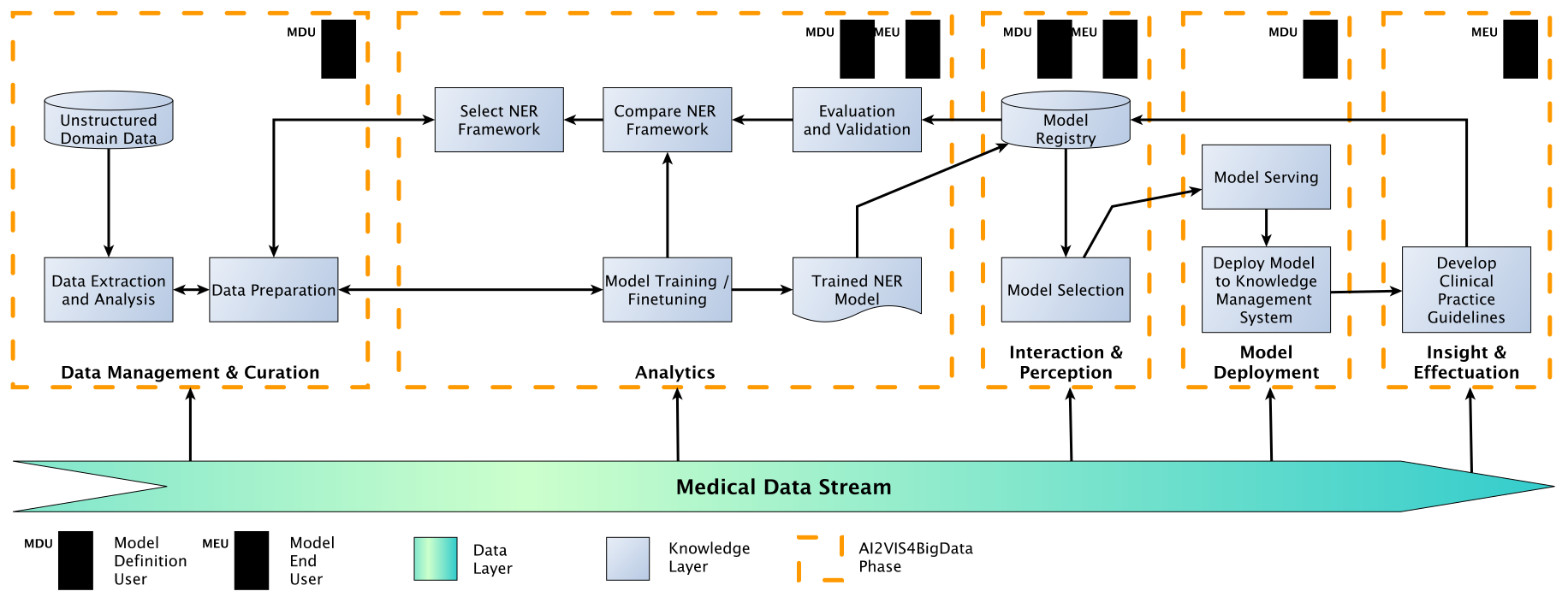
The process model shows the whole path that FIT4NER supports, in five phases from left to right:
- Data management and curation: Unstructured medical data are prepared.
- Analytics: Models are trained, evaluated and compared in different frameworks. The suitable framework is selected.
- Interaction and perception: The best model is chosen.
- Model deployment: The model is transferred to the knowledge management system.
- Insight and effectuation: The model is used in the development of clinical practice guidelines.
The stick figures at the top of the diagram show who acts in which phase: the model definition user (MDU) creates models, the model end user (MEU) applies them.
Use cases: what users can do
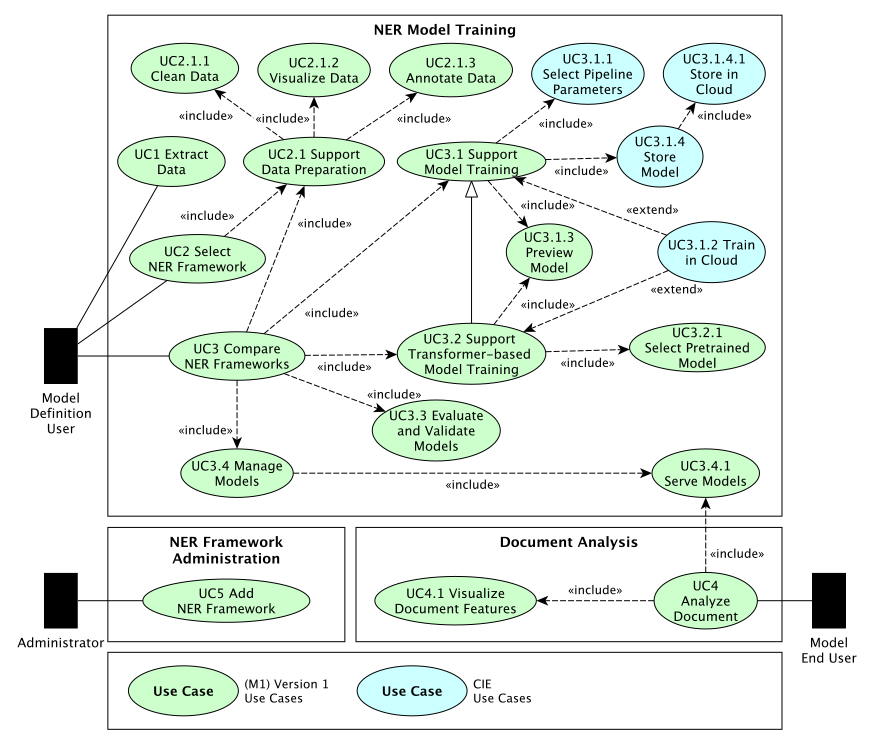
The use case diagram shows which tasks the system performs for whom. Each oval is a use case, each stick figure a role:
- The model definition user extracts and prepares data (cleaning, visualising, annotating), selects frameworks, trains models and compares them.
- The model end user analyses documents with a finished model.
- The administrator adds new frameworks to the system.
Use cases marked in blue come from the CIE project, for example training in the cloud.
Integrated architecture: how the subsystems work together
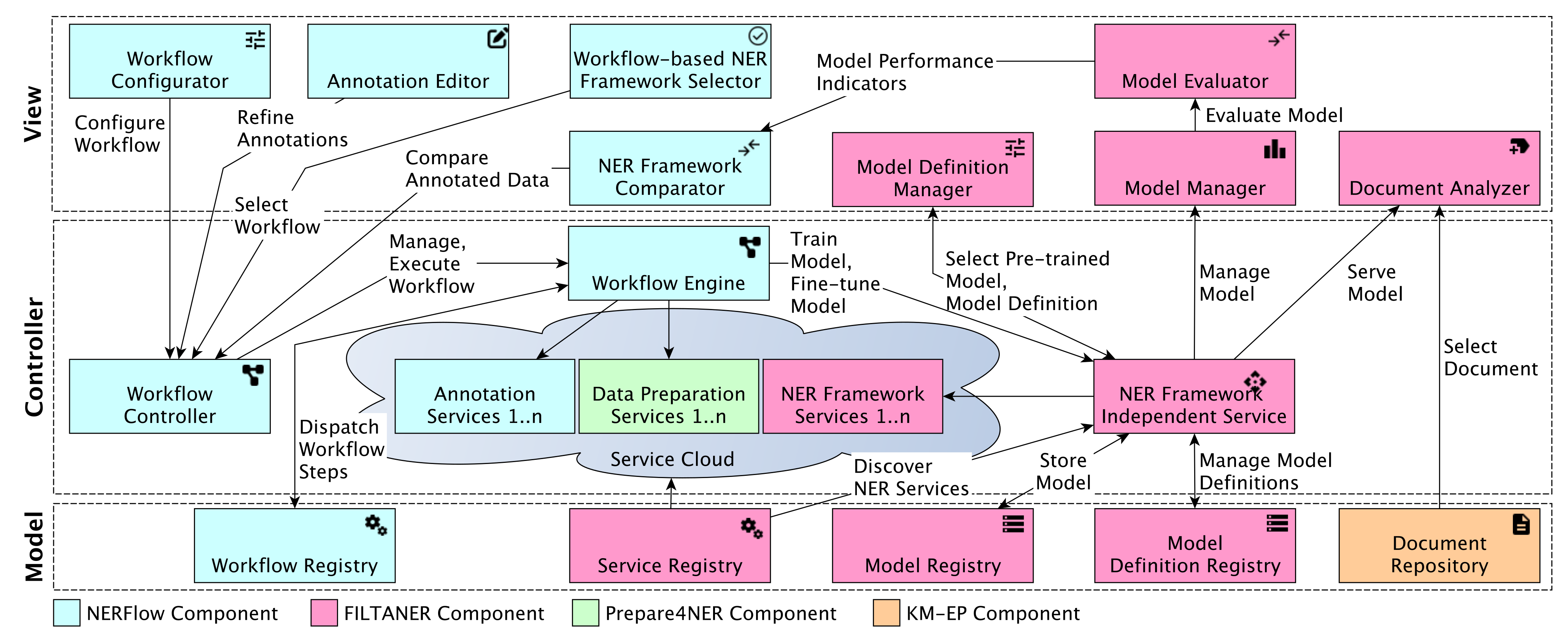
The integrated architecture shows how the subsystems work together in KM-EP. It has three layers following the model-view-controller pattern:
- View (top): the user interfaces.
- Controller (middle): the controlling services.
- Model (bottom): the registries for workflows, services, models and documents.
The colours show the origin: NERFlow controls the workflows and the annotation, Prepare4NER prepares the data, FILTANER trains, evaluates and manages the models independently of the framework, KM-EP provides the documents. The services in the cloud-shaped area in the middle can be exchanged and extended. This lets the system accommodate new frameworks without being replaced.
References
The superscript numbers in the text refer to the following sources.
-
Earl Steinberg, Sheldon Greenfield, Dianne Miller Wolman, Michelle Mancher, and Robin Graham. Clinical practice guidelines we can trust. National Academies Press, 2011. ↩
-
Florian Freund, Philippe Tamla, Bao Tran, and Matthias Hemmje. NERFlow: a workflow-based subsystem of FIT4NER for LLM-assisted medical named entity recognition. Electronics, 15(15):3484, 2026. doi:10.3390/electronics15153484. ↩↩↩
-
Ralph Grishman and Beth M Sundheim. Message understanding conference-6: a brief history. In COLING 1996 Volume 1: The 16th International Conference on Computational Linguistics. 1996. ↩
-
Thoralf Reis, Marco X. Bornschlegl, and Matthias L. Hemmje. AI2VIS4BigData: a reference model for AI-based big data analysis and visualization. In Thoralf Reis, Marco X. Bornschlegl, Marco Angelini, and Matthias L. Hemmje, editors, Advanced Visual Interfaces. Supporting Artificial Intelligence and Big Data Applications, volume 12585 of Lecture Notes in Computer Science, pages 1–18. Springer International Publishing, Cham, 2021. doi:10.1007/978-3-030-68007-7_1. ↩
-
Binh Vu, Yanxin Wu, Haithem Afli, Paul Mc Kevitt, Paul Walsh, Felix Engel, Michael Fuchs, and Matthias Hemmje. A metagenomic content and knowledge management ecosystem platform. In 2019 IEEE International Conference on Bioinformatics and Biomedicine (BIBM), 1–8. IEEE, 2019. ↩↩
-
Florian Freund, Philippe Tamla, Thoralf Reis, Matthias Hemmje, and Paul Mc Kevitt. FIT4NER – towards a framework-independent toolkit for named entity recognition. In Proceedings of the 8th Collaborative European Research Conference (CERC 2023). Barcelona, 2023. Hochschule Darmstadt. doi:10.48444/h_docs-pub-518. ↩↩↩
-
Florian Freund, Philippe Tamla, and Matthias Hemmje. Survey: understand the challenges of machine learning experts using named entity recognition tools. In Computer Science and Information Technology (CS and IT), volume 15, 115–134. Copenhagen, 2025. AIRCC. doi:10.5121/csit.2024.150208. ↩
-
Florian Freund, Philippe Tamla, Frederik Wilde, and Matthias Hemmje. Making medical experts Fit4NER: transforming domain knowledge through machine learning-based named entity recognition. International Journal on Natural Language Computing, 14(2):11–24, 2025. doi:10.5121/ijnlc.2025.14202. ↩↩
-
Florian Freund, Philippe Tamla, Bao Tran, and Matthias Hemmje. Evaluating NERFlow: user-centered assessment of automated LLM-based annotation for medical named-entity recognition. Procedia Computer Science, 280:1350–1355, 2026. doi:10.1016/j.procs.2026.04.183. ↩↩
-
Ryan Donovan, Michael Healy, Huiru Zheng, Felix Engel, Binh Vu, Michael Fuchs, Paul Walsh, Matthias Hemmje, and Paul Mc Kevitt. SenseCare: using automatic emotional analysis to provide effective tools for supporting wellbeing. In 2018 IEEE International Conference on Bioinformatics and Biomedicine (BIBM), 2682–2687. 2018. doi:10.1109/BIBM.2018.8621250. ↩
-
Munir Salman, Dominic Heutelbeck, and Matthias Hemmje. Towards social network support for an applied gaming ecosystem. In 9th European Conference on Games Based Learning, 11. Academic Conferences Ltd, 2015. ↩
-
Florian Freund, Philippe Tamla, and Matthias Hemmje. Towards improving clinical practice guidelines through named entity recognition: model development and evaluation. In 2023 31st Irish Conference on Artificial Intelligence and Cognitive Science (AICS), 1–8. IEEE, 2023. doi:10.1109/AICS60730.2023.10470480. ↩↩
-
FTK e.V. Research Institute for Telecommunications and Cooperation. Artificial intelligence for hospitals, healthcare and humanity (AI4H3). Technical Report, FTK e.V. Research Institute for Telecommunications and Cooperation, Dortmund, Germany, 2020. ↩
-
Philippe Tamla, Florian Freund, and Matthias Hemmje. Supporting named entity recognition and document classification for effective text retrieval. In The role of gamification in software development lifecycle. IntechOpen, 2021. doi:10.5772/intechopen.95076. ↩
-
Philippe Tamla, Florian Freund, Matthias Hemmje, and Paul Mc Kevitt. Evaluation of a system for named entity recognition in a knowledge management ecosystem. In Proceedings of the 14th international joint conference on knowledge discovery, knowledge engineering and knowledge management (IC3K 2022) - KEOD, 19–31. SciTePress / INSTICC, 2022. doi:10.5220/0011374000003335. ↩
-
Philippe Tamla, Benedict Hartmann, Nhan Nguyen, Calvin Kramer, Florian Freund, and Matthias Hemmje. CIE: a cloud-based information extraction system for named entity recognition in AWS, Azure, and medical domain. In Frans Coenen, Ana Fred, David Aveiro, Jan Dietz, Jorge Bernardino, Elio Masciari, and Joaquim Filipe, editors, Knowledge discovery, knowledge engineering and knowledge management, pages 127–148. Springer Nature Switzerland, Cham, 2023. ↩
-
Florian Freund, Philippe Tamla, Sven Stieber, and Matthias Hemmje. From raw text to cross-framework training data: building medical named entity recognition datasets with FIT4NER. Journal of Clinical Informatics, 2(1):025420035, 2026. doi:10.36922/JCI025420035. ↩
-
Florian Freund, Philippe Tamla, Frederik Wilde, and Matthias Hemmje. A FIT4NER generic approach for framework-independent medical named entity recognition. Information, 16(7):554, 2025. doi:10.3390/info16070554. ↩
-
Benedict Hartmann, Philippe Tamla, Florian Freund, and Matthias Hemmje. Fine-tune it like I'm five: supporting medical domain experts in training NER models using cloud, LLM, and auto fine-tuning. In 2023 31st Irish Conference on Artificial Intelligence and Cognitive Science (AICS), 1–8. IEEE, 2023. doi:10.1109/aics60730.2023.10470654. ↩
-
Philippe Tamla, Florian Freund, and Matthias Hemmje. Cloud-based medical named entity recognition: a FIT4NER-based approach. Information, 16(5):395, 2025. doi:10.3390/info16050395. ↩
-
Jay F. Nunamaker Jr, Minder Chen, and Titus D. M. Purdin. Systems development in information systems research. Journal of Management Information Systems, 7(3):89–106, 1990. doi:10.1080/07421222.1990.11517898. ↩
-
Donald A. Norman and Stephen W. Draper. User Centered System Design: New Perspectives on Human-Computer Interaction. L. Erlbaum Associates Inc., USA, 1986. ↩