Framework-Independent Toolkit for Named Entity Recognition
FIT4NER is a doctoral research project by Florian Freund at the FernUniversität in Hagen, Chair of Multimedia and Internet Applications. It investigates how medical professionals without programming skills can have medical terms recognised automatically in free text. The method is called Named Entity Recognition (NER) and is based on machine learning.
Problem
Much of medical knowledge exists as free text: in scientific literature, clinical practice guidelines and clinical letters. NER automatically marks terms such as diagnoses, symptoms or drugs in these texts and makes the knowledge easier to access.
Several software tools for NER exist, known as frameworks, for example spaCy, Stanford CoreNLP or Hugging Face Transformers. They differ in data formats, interfaces and programming languages. Training a model, evaluating it or comparing several frameworks requires programming skills, machine-learning knowledge and computing power. Medical professionals usually lack these.
Approach
FIT4NER offers one user interface for several NER frameworks. Without programming, medical professionals can
- prepare training data,
- train and evaluate models with different frameworks,
- compare the results and select the suitable model.
Computationally intensive steps can be moved to the cloud (AWS, Azure, GCP). FIT4NER is integrated into the knowledge management system KM-EP (Content and Knowledge Management Ecosystem Portal). Documents, text collections, models and results are kept there in one place.
Overview
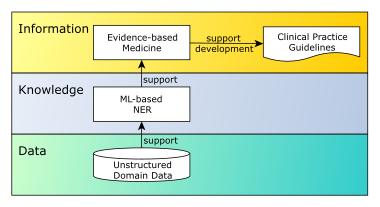
The overall process model shows in three layers where FIT4NER comes in:
- Information (top): Experts develop clinical practice guidelines according to the principles of evidence-based medicine.
- Knowledge (middle): NER recognises the relevant terms in the texts and makes them usable for guideline work. This is where FIT4NER helps.
- Data (bottom): The evidence is contained in large amounts of unstructured medical text.
Research questions
FIT4NER investigates three questions:
- How can medical professionals try out NER frameworks, compare them and select the suitable one?
- How can they use and manage cloud resources cost-efficiently?
- How can an information system be designed that enables them to apply NER and keeps pace with the development of the frameworks?
The wording of the research questions is given in the background.
-
Background
Terms, problem statement, history, research questions and models.
-
Publications
Publications on FIT4NER and its subsystems.
Publications
The publications on FIT4NER and its subsystems in chronological order. The full references are given below.
- 2023: Basic idea and architecture of FIT4NER (CERC 2023) 1
- 2023: Process models for developing clinical practice guidelines with NER (AICS 2023) 2
- 2023: CRM4NER, training and fine-tuning in the AWS cloud (AICS 2023) 3
- 2025: Survey of ML experts on selecting and comparing NER tools (CS and IT 2025) 4
- 2025: FIT4NER for medical experts, survey and system (IJNLC 2025) 5
- 2025: Training in the Azure cloud (Information 2025) 6
- 2025: FILTANER, framework-independent training (Information 2025) 7
- 2026: User evaluation of NERFlow (Procedia Computer Science 2026) 8
- 2026: Prepare4NER, preparing training data (Journal of Clinical Informatics 2026) 9
- 2026: NERFlow, LLM-assisted annotation in workflows (Electronics 2026) 10
-
Florian Freund, Philippe Tamla, Thoralf Reis, Matthias Hemmje, and Paul Mc Kevitt. FIT4NER – towards a framework-independent toolkit for named entity recognition. In Proceedings of the 8th Collaborative European Research Conference (CERC 2023). Barcelona, 2023. Hochschule Darmstadt. doi:10.48444/h_docs-pub-518. ↩
-
Florian Freund, Philippe Tamla, and Matthias Hemmje. Towards improving clinical practice guidelines through named entity recognition: model development and evaluation. In 2023 31st Irish Conference on Artificial Intelligence and Cognitive Science (AICS), 1–8. IEEE, 2023. doi:10.1109/AICS60730.2023.10470480. ↩
-
Benedict Hartmann, Philippe Tamla, Florian Freund, and Matthias Hemmje. Fine-tune it like I'm five: supporting medical domain experts in training NER models using cloud, LLM, and auto fine-tuning. In 2023 31st Irish Conference on Artificial Intelligence and Cognitive Science (AICS), 1–8. IEEE, 2023. doi:10.1109/aics60730.2023.10470654. ↩
-
Florian Freund, Philippe Tamla, and Matthias Hemmje. Survey: understand the challenges of machine learning experts using named entity recognition tools. In Computer Science and Information Technology (CS and IT), volume 15, 115–134. Copenhagen, 2025. AIRCC. doi:10.5121/csit.2024.150208. ↩
-
Florian Freund, Philippe Tamla, Frederik Wilde, and Matthias Hemmje. Making medical experts Fit4NER: transforming domain knowledge through machine learning-based named entity recognition. International Journal on Natural Language Computing, 14(2):11–24, 2025. doi:10.5121/ijnlc.2025.14202. ↩
-
Philippe Tamla, Florian Freund, and Matthias Hemmje. Cloud-based medical named entity recognition: a FIT4NER-based approach. Information, 16(5):395, 2025. doi:10.3390/info16050395. ↩
-
Florian Freund, Philippe Tamla, Frederik Wilde, and Matthias Hemmje. A FIT4NER generic approach for framework-independent medical named entity recognition. Information, 16(7):554, 2025. doi:10.3390/info16070554. ↩
-
Florian Freund, Philippe Tamla, Bao Tran, and Matthias Hemmje. Evaluating NERFlow: user-centered assessment of automated LLM-based annotation for medical named-entity recognition. Procedia Computer Science, 280:1350–1355, 2026. doi:10.1016/j.procs.2026.04.183. ↩
-
Florian Freund, Philippe Tamla, Sven Stieber, and Matthias Hemmje. From raw text to cross-framework training data: building medical named entity recognition datasets with FIT4NER. Journal of Clinical Informatics, 2(1):025420035, 2026. doi:10.36922/JCI025420035. ↩
-
Florian Freund, Philippe Tamla, Bao Tran, and Matthias Hemmje. NERFlow: a workflow-based subsystem of FIT4NER for LLM-assisted medical named entity recognition. Electronics, 15(15):3484, 2026. doi:10.3390/electronics15153484. ↩